✨ This article was AI edited. Editorial responsibility: RecipesFromTheHomestead.com.
Produced with AI. This article was artificially generated. Editorial responsibility: RecipesFromTheHomestead.com.
Making your own wine is the artisanal craft of crushing fresh garden or foraged fruit, preparing a balanced sugary must with natural acid and tannin adjustments, and guiding Saccharomyces yeast through aerobic primary and anaerobic secondary fermentation to craft custom bottled vintages.
There is a profound, quiet satisfaction in pouring a glass of handcrafted wine produced from fruit you harvested with your own hands. Beyond commercial grape vineyards, the homestead tradition of “country winemaking” embraces wild blackberries, elderberries, orchard apples, garden dandelions, and stone fruits. By understanding the core fourfold balance of sugar, acid, tannin, and yeast nutrition, any home fermenter can transform summer fruit harvests into crystal-clear, aromatic wines that age gracefully for years.
The Four Foundations of Balanced Country Wine
Unlike wine grapes (Vitis vinifera) which naturally contain the perfect proportions of sugar, water, acid, and tannin, wild and orchard fruits require simple adjustments before pitching yeast:
- Specific Gravity & Sugar Target: Most wild berries and orchard apples contain only 7% to 10% natural sugar (approx. 1.035 to 1.045 specific gravity). To produce a stable table wine with 11.5% to 13.0% alcohol by volume, cane sugar or clover honey must be added (chaptalization) until the hydrometer reads between 1.085 and 1.095.
- Total Acidity (TA) Calibration: Wine requires tartaric, malic, or citric acids (pH 3.2 to 3.6) to provide crisp refreshment, prevent flat oxidation, and inhibit spoilage bacteria. An acid blend powder (combining citric, malic, and tartaric acids) easily balances low-acid fruits.
- Astringency & Mouthfeel (Wine Tannin): Fruit wines often lack the natural grape-skin tannins that give red wine its pleasant grip and cellar structure. Adding 0.25 teaspoon of powdered wine tannin or 1 cup of strong black tea per gallon builds robust backbone.
- Yeast Assimilable Nitrogen (YAN): Fruit musts are naturally deficient in nitrogen and micronutrients required by yeast cells during rapid reproduction. Yeast nutrient (diammonium phosphate and vitamin B1) prevents yeast stress and rotten-egg sulfur odors.
Fruit Suitability Matrix: What Makes the Best Country Wine?
| Fruit Variety | Pounds Needed per Gallon | Natural Acid Level | Tannin Requirement | Recommended Aging Window |
|---|---|---|---|---|
| Wild Blackberries | 4.0 – 5.0 lbs (2.0kg) | High (tartaric/malic) | Moderate (seeds provide tannin) | 6 to 12 Months |
| Blueberries / Huckleberries | 4.5 – 5.5 lbs (2.3kg) | Low (requires acid blend) | High (add black tea/tannin) | 9 to 15 Months |
| Black Elderberries | 3.0 – 3.5 lbs (1.5kg) | Medium | Naturally very high | 12 to 24 Months |
| Orchard Peaches / Plums | 4.0 – 5.0 lbs (2.0kg) | Low to Medium | Low (add 0.5 tsp tannin) | 4 to 8 Months |
| Wild Dandelion Blossom | 2.0 quarts picked petals | Zero (add citrus juice) | Add tannin and white grape concentrate | 12 Months |
Master Blueprint: 1-Gallon Wild Blackberry Homestead Wine
This master small-batch formula requires zero bulky commercial crushers and fits conveniently on a kitchen countertop. Yields 5 standard 750ml bottles.
Ingredients Formulation
- Fresh or Frozen Ripe Blackberries: 4.5 lbs (2.0kg), thoroughly rinsed and sorted.
- Pure Granulated Cane Sugar: Approx. 2.0 to 2.25 lbs (900g to 1000g), dissolved to reach 1.090 SG.
- Spring Water (Chlorine-Free): Approx. 3 quarts (to reach 1 gallon volume).
- Potassium Metabisulfite (Campden Tablet): 1 tablet, crushed.
- Pectic Enzyme Powder: 0.5 teaspoon (crucial for fruit clarification).
- Acid Blend Powder: 1 teaspoon (or juice of 1 whole lemon).
- Yeast Nutrient: 1 teaspoon.
- Wine Yeast: 0.5 packet (approx. 2.5g) Lalvin 71B (enhances fresh fruity esters) or EC-1118.
Step-by-Step Homestead Fermentation Protocol
- Freeze and Thaw Fruit: Freezing wild berries ruptures their cellular membranes. When thawed, the fruit releases maximum juice, anthocyanins, and sugars with minimal pressing effort.
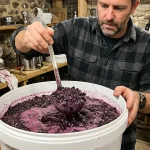
- Bag and Crush in Primary Vessel: Place the thawed berries inside a sanitized fine-mesh nylon straining bag and tie the top tightly. Place the bag into a sanitized 2-gallon food-grade bucket. Using clean hands or a potato masher, crush the berries thoroughly inside the bag.
- Mix Must and Sanitize: In a separate pot, dissolve the cane sugar in warm spring water. Pour the sugar syrup over the bagged fruit. Stir in the acid blend, yeast nutrient, and 1 crushed Campden tablet. Cover the bucket with a clean linen towel and allow to rest for 24 hours to sanitize wild vineyard microbes.
- Add Enzyme and Inoculate Yeast: After 24 hours, stir in the pectic enzyme and wait 2 hours. Measure the Specific Gravity with a hydrometer (target: 1.088 to 1.092). Rehydrate the wine yeast in 2 oz of warm water (100°F / 38°C) for 15 minutes, then pitch onto the surface of the must. Fit the bucket lid loosely or cover with a sanitized towel.
- Primary Aerobic Fermentation: Keep the bucket at 68°F to 75°F (20°C to 24°C). The yeast will begin bubbling vigorously within 24 hours. Twice a day, submerge and squeeze the fruit bag with a sanitized spoon to extract color and prevent surface mold.
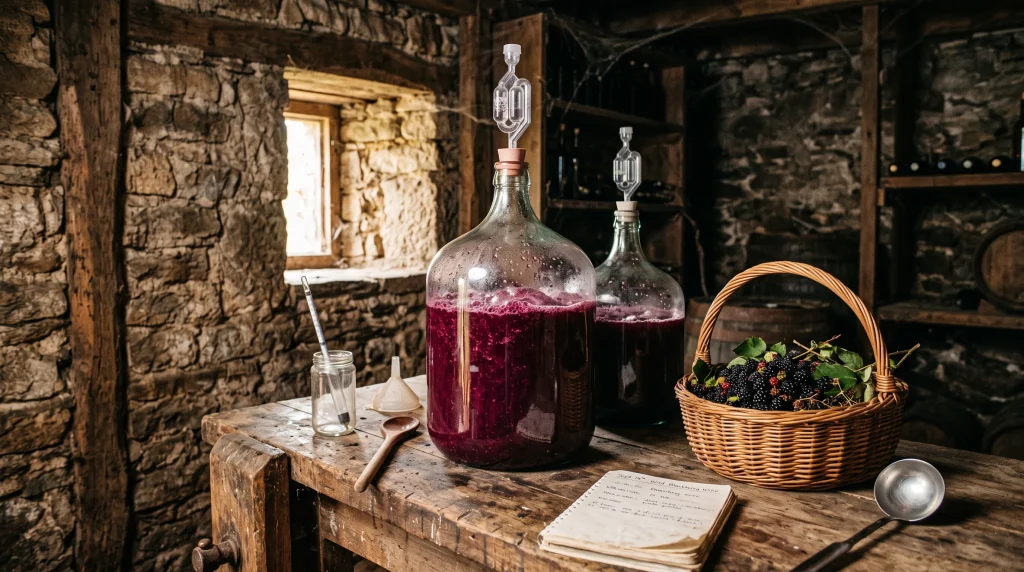
- Press and Rack to Secondary Demijohn: On Day 6 or 7, when specific gravity drops below 1.015, lift the nylon bag, let it drain completely without harsh twisting (which releases bitter seed astringency), and discard the fruit pulp. Siphon the liquid into a 1-gallon glass carboy, filling up to the neck. Install a rubber bung and three-piece airlock.
- Secondary Fermentation and Clearing: Let the carboy sit in a cool, dark room for 3 weeks until bubbling ceases and a thick layer of yeast sediment settles to the bottom. Siphon the clear wine into a clean jug, add 0.5 crushed Campden tablet to prevent oxidation, and age for 3 to 6 months before bottling into corked wine bottles.
Bottling, Cellaring, and Maturation
Patience is the defining ingredient of exceptional winemaking:
- Verifying Full Dryness: Never bottle until specific gravity reads below 0.996 for two consecutive weeks. Bottling wine with residual fermentable sugars creates dangerous pressure buildup (“bottle bombs”).
- Cellar Longevity: Store filled bottles horizontally in a dark cellar at 55°F (13°C). A wild blackberry or plum wine hits its magnificent aromatic peak between 9 and 18 months in the bottle.
Explore more beverage guides with our tutorial on winemaking at home techniques and check out our popular guide on Stardew Valley wine crafting.
Frequently Asked Questions About How to Make Your Own Wine
Can I use tap water for making wine at home?
Avoid municipal tap water containing chlorine or chloramines, which react with yeast compounds to produce medicinal, plastic-like chlorophenol off-flavors. Use filtered spring water, reverse-osmosis water, or boil and cool tap water to drive off chlorine before mixing your must.
How do I make my wine sweeter if it ferments completely dry?
To safely sweeten (backsweeten) dry wine, you must first add potassium sorbate (0.5 tsp per gallon) and potassium metabisulfite (1 crushed Campden tablet per gallon). These compounds prevent dormant yeast cells from restarting fermentation. After 24 hours, stir in simple sugar syrup or honey to taste.
Why is my homemade wine cloudy and how do I clear it?
Cloudiness in fruit wine is caused either by suspended yeast cells or fruit pectin haze. If you forgot pectic enzyme at the start, add a double dose of pectic enzyme now. Alternatively, cold-crashing the carboy at 35°F to 40°F (2°C to 4°C) for one week will cause suspended particles to drop crystal-clear to the bottom.
Get our latest guides, news, and insights highlighted in your Google Search & AI Overviews.