✨ This article was AI edited. Editorial responsibility: RecipesFromTheHomestead.com.
Produced with AI. This article was artificially generated. Editorial responsibility: RecipesFromTheHomestead.com.
Baking with butter recipes are classic confectionery and pastry preparations—such as laminated croissants, tender pound cakes, and crisp shortbread—that harness the unique 80% butterfat and 16% water composition of churned cream to engineer steam leavening, gluten tenderization, and rich golden Maillard coloration.
In the culinary universe, butter is the undisputed sovereign of the baker’s pantry. Unlike liquid vegetable oils or shortenings that provide one-dimensional lubrication, butter is a complex solid emulsion that behaves dynamically at different temperatures. Whether cut ice-cold into flour to create shatteringly crisp pastry layers, creamed with sugar at room temperature to trap microscopic air cells in a fluffy sponge cake, or browned in a pan to develop nutty toasted milk solids, butter defines the texture, structure, and aroma of world-class baked goods.
The Physics & Chemistry of Butter in the Oven
Mastering baking with butter requires understanding how butterfat and water behave inside flour doughs:
- Steam Leavening in Lamination: Butter is composed of roughly 80% milkfat, 16% water, and 4% milk proteins. In flaky pie crusts, biscuits, and croissants, cold sheets of butter remain separate from the flour matrix. When placed into a hot oven (400°F–425°F / 205°C–220°C), the 16% water instantly boils into expanding steam. This steam puffs apart the surrounding starch layers before the butterfat melts to fry each distinct flour sheet into crisp, paper-thin flakes.
- Aeration Through Mechanical Creaming: When beating room-temperature butter (65°F–68°F / 18°C–20°C) with granulated sugar crystals, the sharp edges of the sucrose carve millions of microscopic pocket cavities into the malleable fat. These trapped air cells expand when leaveners (baking powder or soda) release carbon dioxide, resulting in soft, fine-crumbed cakes.
- Gluten Shortening & Tenderness: The word “shortbread” derives from butterfat’s ability to coat wheat proteins (gliadin and glutenin) in an impermeable lipid film. This prevents the proteins from linking with water to form elastic gluten chains, yielding melt-in-your-mouth tenderness rather than chewy bread texture.
Butter Temperature Guide: When to Use Cold, Room Temp, or Melted
| Butter State | Ideal Temperature Range | Primary Chemical Role | Signature Baked Applications |
|---|---|---|---|
| Ice-Cold (Cubed / Grated) | 35°F – 42°F (2°C – 6°C) | Steam generation & pastry lamination | All-butter pie crusts, southern flaky biscuits, puff pastry |
| Plastic / Room Temperature | 65°F – 68°F (18°C – 20°C) | Mechanical air trapping & emulsification | Classic pound cakes, butter cookies, creamed chocolate chip cookies |
| Liquid Melted & Cooled | 85°F – 95°F (29°C – 35°C) | Moisture retention & chewy density | Fudgy dark brownies, dense skillet blondies, tender muffins |
| Browned Butter (Beurre Noisette) | Hot toasted (milk solids caramelized) | Nutty aromatic depth & rich flavor | French financiers, browned butter chocolate chunk cookies, madeleines |
Master Blueprint: Classic European All-Butter Shortbread
This master 3-ingredient formula exemplifies pure butter baking. Yields 16 thick, crumbly, melt-in-your-mouth shortbread wedges.
Ingredients Formulation
- Unsalted European-Style High-Fat Butter: 1 cup (2 sticks / 226g), slightly softened to 65°F (18°C), 82% to 84% butterfat preferred.
- Powdered Confectioners’ Sugar: 0.5 cup (60g), sifted (powdered sugar contains fine cornstarch, ensuring a velvety crumb).
- Pure Vanilla Bean Paste (or Extract): 1 teaspoon (5ml).
- Fine Sea Salt: 0.5 teaspoon (balances the rich butter lipids).
- Unbleached All-Purpose Flour: 2 cups (240g), spooned and leveled.
- Granulated Sugar for Dusting: 1 tablespoon (for sparkling surface finish).
Step-by-Step Technical Baking Protocol
- Cream the Butter and Sugar Gently: In a stand mixer fitted with the paddle attachment (or using a hand mixer), beat the softened butter, powdered sugar, and salt on low speed for 2 minutes until completely smooth and pale, but avoid whipping excessive air. Shortbread relies on density, not sponge rise. Beat in the vanilla bean paste.
- Incorporate the Flour: Add the sifted all-purpose flour all at once. Mix on the lowest speed just until the flour is moistened and a soft, crumbly dough forms around the paddle (approx. 45 to 60 seconds). Stop mixing immediately to avoid gluten development.
- Press into Baking Tart Pan: Lightly grease a 9-inch round fluted tart pan with a removable bottom (or an 8-inch square baking dish). Dump the crumbly dough into the pan. Using clean hands or the flat bottom of a glass measuring cup, press the dough firmly and evenly across the entire bottom.
- Dock and Score the Dough: Using a fork, prick the dough all over in neat rows (docking) to allow trapped steam to escape evenly during baking without creating air bubbles. Using a sharp knife, score the dough into 16 triangular wedges or rectangular fingers, cutting halfway through the thickness.
- Chill Before Baking: Transfer the prepared pan to the refrigerator for 30 minutes. Chilling resolidifies the butterfat crystals, ensuring the shortbread retains clean, sharp edges and does not spread greasy in the oven.
- Slow Bake: Preheat oven to 325°F (165°C). Bake the shortbread on the middle rack for 30 to 35 minutes, until the surface is set, pale ivory, and the outer edges show the faintest golden hue. Remove from oven and immediately dust with 1 tablespoon of granulated sugar. Re-cut along the scored lines while still hot. Let cool completely in the pan for 1 hour before serving.
The Best Recipes for Baking with Butter
Flaky & Laminated Delights
- Grandmother’s All-Butter Mile-High Biscuits: Grated frozen butter folded six times for twenty-four distinct flaky layers.
- Traditional French Butter Croissants: Hand-laminated yeasted dough rolled around an 84% butterfat butter block.
- Rustic Butter Puff Pastry (Pâte Feuilletée): The golden foundation for savory tarts and sweet fruit turnovers.
Cakes and Tender Crumb Confections
- Old-Fashioned Kentucky Butter Cake: Dense vanilla sponge soaked with warm butter, sugar, and rum syrup while still hot.
- French Almond Financiers: Nutty browned butter (beurre noisette) baked with almond flour and egg whites.
- Classic Golden Yellow Layer Cake: Velvet crumb made by the reverse creaming method with chilled cubed butter.
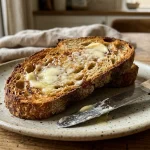
Pair your baked treats with our homemade soft bakery butter bread loaves and discover how to make smooth and creamy plant-based butter.
Frequently Asked Questions About Baking with Butter
Why should I always bake with unsalted butter instead of salted?
Different dairy brands add varying amounts of salt (ranging from 1.2% to over 2.5% sodium), making it impossible to control seasoning. Furthermore, unsalted butter is generally fresher on supermarket shelves because salt acts as a preservative, allowing salted butter to sit longer in distribution.
What is European-style butter and does it make a difference in baking?
European-style butter (such as Kerrygold or Plugrá) is churned to a minimum of 82% to 84% butterfat, compared to standard American butter which contains 80% butterfat. The lower water content creates flakier pie crusts, crisper cookies, and richer mouthfeel.
How do I quickly soften cold butter to room temperature without melting it?
Fill a glass bowl or measuring cup with boiling water for 2 minutes, pour the water out, and invert the hot empty bowl over your wrapped stick of butter on the counter. The residual trapped radiant heat will soften the butter to a perfect 65°F in just 10 minutes without melting a single droplet.
Get our latest guides, news, and insights highlighted in your Google Search & AI Overviews.