✨ This article was AI edited. Editorial responsibility: RecipesFromTheHomestead.com.
Produced with AI. This article was artificially generated. Editorial responsibility: RecipesFromTheHomestead.com.
Making your own wine at home is the artisanal craft of transforming fresh fruit juices or whole crushed fruit into stabilized, shelf-stable alcoholic beverages through controlled anaerobic yeast fermentation, rigorous microbial sanitization, systematic hydrometer monitoring, and secondary vessel clarification.
Crafting small-batch wine in your homestead kitchen or basement cellar is one of the most rewarding self-sufficiency skills you can develop. Far from an arcane laboratory science, home vinification is an ancient, natural bioprocess governed by simple principles of microbiology and environmental control. With a modest investment in food-grade fermentation vessels, an inexpensive triple-scale hydrometer, and proper sanitizing protocol, you can produce cellar-worthy red, white, and country fruit wines that rival commercial boutique vintages at a fraction of the retail cost.
Essential Home Winemaking Equipment: The Beginner’s Toolkit
Successful fermentation hinges on utilizing proper food-grade materials that resist acidic corrosion and eliminate bacterial harboring points. Never substitute non-food-grade construction plastics or aluminum cookware, which react deleteriously with wine acids.
- Primary Fermentation Bucket (6.5 to 7.5 Gallons): A wide-mouth, food-grade HDPE bucket equipped with an airtight lid and grommeted airlock hole. The extra headspace accommodates the vigorous foam and carbon dioxide cap generated during active aerobic fermentation.
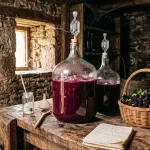
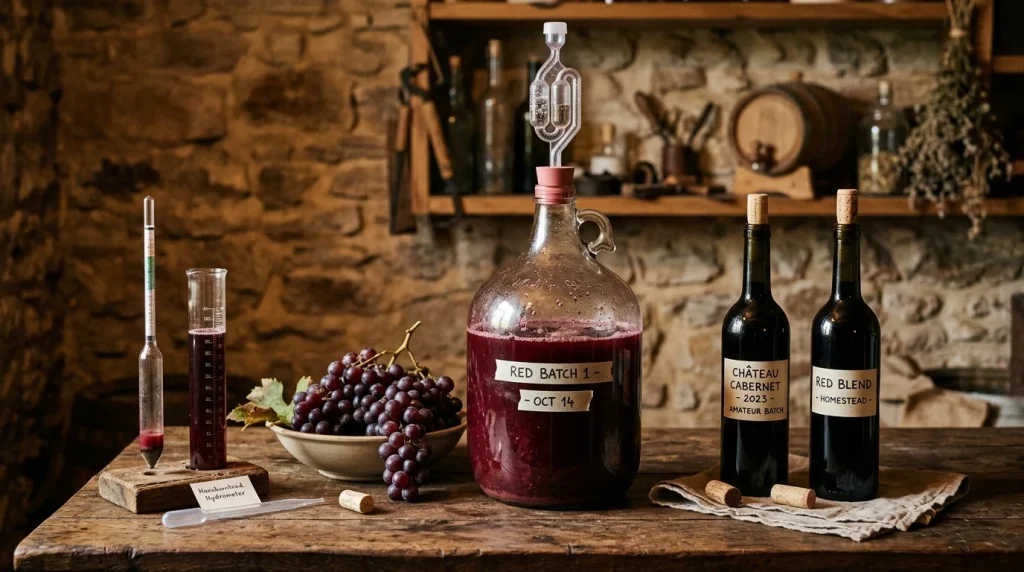
- Secondary Fermenter / Glass Carboy (5 Gallons or 1 Gallon): Narrow-neck glass or PET plastic demijohns that minimize oxygen exposure during the weeks-long secondary anaerobic clarification phase.
- Three-Piece Airlock and Silicone Bung: Allows carbon dioxide gas to vent outward while maintaining a sterile liquid barrier that prevents airborne wild bacteria, fruit flies (Drosophila), and oxygen from entering.
- Triple-Scale Specific Gravity Hydrometer & Test Jar: Measures sugar density relative to pure water (1.000). Essential for calculating potential alcohol by volume (ABV), diagnosing stuck fermentations, and determining dryness.
- Auto-Siphon & Food-Grade Vinyl Transfer Tubing: Racks clear wine from the settled yeast lees (sediment) without disturbing bottom trub or aerating finished wine.
- No-Rinse Sanitizer (Star San or Potassium Metabisulfite): Commercial brewing sanitizer formulated to eliminate wild yeast, mold spores, and acetobacter (vinegar-forming bacteria) on contact.
Fermentation Stages: Primary vs. Secondary Anaerobic Management
| Fermentation Phase | Duration | Atmospheric Condition | Specific Gravity Range | Primary Biochemical Objective |
|---|---|---|---|---|
| Must Preparation & Maceration | 24–48 Hours | Aerobic (loose towel cover) | 1.080 – 1.095 (Target Start) | Sulfiting wild yeasts, enzymatic pectin breakdown, flavor extraction |
| Active Primary Fermentation | 5–7 Days | Aerobic / Semi-Closed | 1.085 $\rightarrow$ 1.020 – 1.010 | Rapid yeast biomass expansion, high CO2 production, punch downs |
| Secondary Fermentation | 2–4 Weeks | Strict Anaerobic (Airlocked) | 1.010 $\rightarrow$ 0.996 – 0.992 | Complete attenuation of residual sugars, conversion to ethanol |
| Racking & Bulk Aging | 2–6 Months | Zero Headspace Anaerobic | 0.992 – 0.996 (Terminal) | Sedimentation of yeast lees, tannin softening, natural fining |
| Bottling & Cellaring | 6–24 Months | Corked Glass Bottles | Stable Terminal Gravity | Ester maturation, bouquet development, bottle conditioning |
Master Step-by-Step Blueprint: 1-Gallon Red Grape Homestead Wine
This beginner-friendly master recipe yields approximately five standard 750ml bottles of balanced, medium-bodied red table wine with an estimated 12.5% ABV. It teaches foundational techniques without requiring an expensive industrial grape crusher.
Formula & Ingredients
- 100% Pure Dark Grape Juice Concentrate or Fresh Pressed Must: 1 gallon (3.8 liters), free from chemical sorbates or benzoate preservatives.
- Granulated White Sugar: 1.5 to 2.5 cups (if chaptalization is needed to reach 1.085–1.090 specific gravity).
- Cultured Winemaking Yeast (Lalvin EC-1118 or RC-212): 0.5 packet (2.5g), rehydrated in warm filtered water.
- Diammonium Phosphate Yeast Nutrient: 1 teaspoon (5g), supplies critical nitrogen for healthy cell reproduction.
- Pectic Enzyme Powder: 0.5 teaspoon, prevents permanent pectin haze and clarifies fruit solids.
- Acid Blend (Tartaric, Malic, Citric): 0.75 teaspoon, provides crisp palate balance.
- Wine Tannin Powder: 0.25 teaspoon, imparts astringency, deep mouthfeel, and longevity.
- Campden Tablets (Potassium Metabisulfite): 2 tablets crushed finely (1 for initial must, 1 for bottling stabilization).
Step-by-Step Protocol
- Sanitize Everything: Submerge your primary bucket, hydrometer, spoon, and airlock in Star San solution for 60 seconds. In winemaking, 90% of failures stem from bacterial contamination. Cleanliness guarantees success.
- Prepare the Must: Pour the grape juice into the primary fermenter. Whisk in the pectic enzyme, yeast nutrient, acid blend, and wine tannin until fully dissolved.
- Measure Starting Gravity: Fill your test cylinder with must and float the hydrometer. Note the specific gravity. Aim for 1.085 to 1.090 (which yields approximately 11.5% to 12.5% ABV). If the reading is lower, dissolve granulated sugar in warm water and blend into the must until the target gravity is achieved.
- Pitch Rehydrated Yeast: Dissolve your yeast in 50ml of warm water (100°F–105°F / 38°C) with a pinch of sugar for 15 minutes until frothy. Pitch the yeast slurry over the must. Stir gently.
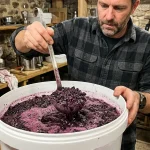
- Primary Aerobic Fermentation: Cover the bucket with a clean, lint-free cotton tea towel secured with an elastic band. Place in a dark room maintained between 68°F and 75°F (20°C to 24°C). Within 24 to 36 hours, vigorous bubbling will occur. Stir the must daily with a sanitized spoon to incorporate oxygen and disperse the surface cap.
- Racking to Secondary: After 5 to 7 days, check your hydrometer. When gravity drops below 1.020, use your auto-siphon to gently transfer the liquid off the bottom lees into a sanitized 1-gallon glass carboy. Fill to within 1.5 inches of the stopper. Fit the silicone bung and fill the airlock with sanitizer water.
- Anaerobic Aging & Clarification: Allow the carboy to sit undisturbed for 4 to 6 weeks. The airlock will bubble slowly as fermentation finishes and dead yeast cells settle out. Rack the wine a second time into a clean carboy when sediment exceeds 0.5 inches on the bottom.
- Stabilization & Bottling: When specific gravity reads 0.994 or lower and remains stable across three consecutive days, rack into clean bottles. Dissolve 1 crushed Campden tablet and 0.5 teaspoon potassium sorbate into the batch to prevent bottle re-fermentation. Cork with fresh agglomerated corks and store upright for 3 days, then store on their side in a cool, dark cellar for at least 3 to 6 months before enjoying.
Crucial Troubleshooting: Preventing Common Homebrewing Faults
Anticipating biochemical anomalies allows you to correct imbalances before they ruin your batch:
- The Rotten Egg / Hydrogen Sulfide Smell: Stressed yeast running low on free amino nitrogen (YAN) produces volatile sulfur compounds ($H_2S$). Immediately aerate the must during primary fermentation and add 0.5 teaspoon yeast nutrient. Racking over a clean copper pipe or copper wire rapidly precipitates sulfides.
- Stuck Fermentation (Gravity Halts Above 1.030): Cold temperatures or alcohol shock can stall yeast. Move the carboy to a 72°F space, gently swirl the bottom yeast bed without splashing oxygen, and pitch a hardy killer-factor yeast strain like Lalvin EC-1118.
- Vinegar Aroma (Acetobacter Contamination): If oxygen enters a secondary vessel with wild acetobacter, alcohol oxidizes into acetic acid. Always maintain airlocks filled with liquid and ensure carboy neck headspace never exceeds 1.5 inches during secondary aging.
Deepen your homestead culinary expertise by browsing our guides to natural fermentation winemaking and crafting wild chokecherry and native fruit wines.
Frequently Asked Questions About Home Winemaking
Is it legal to make your own wine at home?
In the United States and most European nations, federal law permits adults of legal drinking age to brew up to 100 gallons of wine per year for a single adult household, or up to 200 gallons per year for a household with two or more adults, strictly for personal and non-commercial consumption.
Can I use regular bread yeast instead of wine yeast?
While baker’s yeast will ferment sugar into ethanol, it typically stalls out around 6% to 8% ABV and leaves a heavy bready, murky off-flavor that fails to flocculate (settle). Cultivated wine yeasts like Lalvin EC-1118 or Premier Rouge are selected for high alcohol tolerance (up to 18% ABV), neutral flavor profiles, and compact sediment compaction.
How long should homemade wine age before opening?
White and country fruit wines are generally approachable after 3 to 6 months of bottle cellaring. Full-bodied red grape wines with substantial tannins benefit significantly from 12 to 18 months of aging, which rounds out harsh astringency and allows complex tertiary fruit esters to mature.
Get our latest guides, news, and insights highlighted in your Google Search & AI Overviews.